The Turtle Island


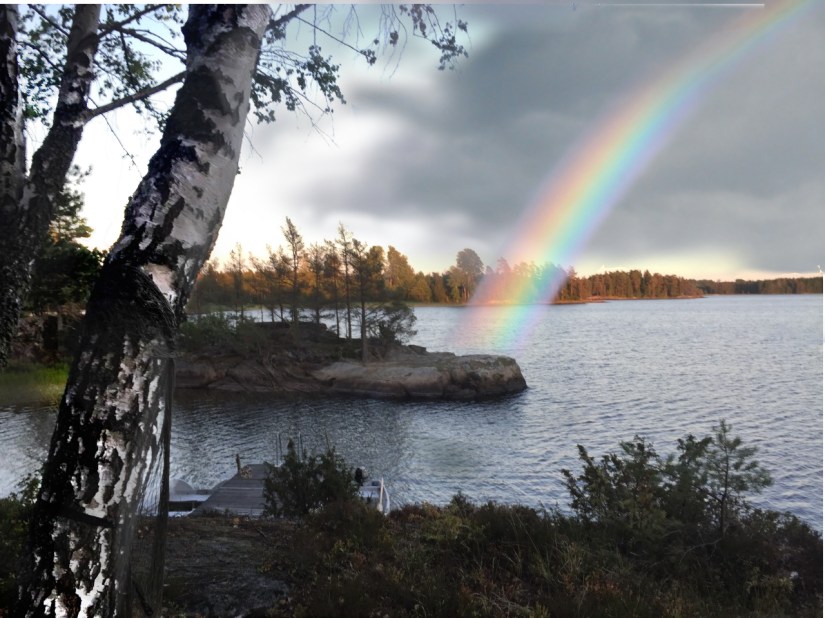
The photo shows how the rainbow appears over Turtle Island, created with Gimp Image Manipulation program.


Here is how it all began in 2003. My daughter was only eight years old when the teacher asked her to write a legend, and she didn’t know where to start or what she should write – how to create the story. So she needed a helping hand, and I was eager to assist her.

At that time, I worked as a designer in a production company. There we often used the brainstorming method when we developed new ideas. But now the answer was so obvious to me.

“Turtle Island”, I suggested, and she wholeheartedly agreed with me.

Earlier that summer we had a strange incident at our cabin, while the whole family gathered outdoor. The sun shone through openings in the clouds, but it did not rain where we stood. Suddenly our eyes were drawn to the heavens around the nearby peninsula, named Turtle Island because it looks like a turtle.

At a long distance, two rainbows arose over the lake. Then a third rainbow came, much closer, only thirty meters away. It was rising from the head of the turtle, and the children and I run towards it as fast as we could. When we arrived, the rainbow was just three meters away from us, not more. Whereas for my wife, who stood back at the cabin, it looked like we were in the middle of it. It was so awesome, even though rainbows are natural – it still was a once in a lifetime experience.

With this event fresh in our memory, we wrote The legend of Turtle Island, which her teacher and fellow students liked very much. It was encouraging, of course, and I wanted to write more. And more there was – much more! Lots of trial and error. Year after year! It took me twelve years of hard work before I was able to publish a novel that I am still happy with today.

In 2015 «The White Lady» became a bestseller in Halden.

Created with GIMP

The Curse of Goodness

cover start1

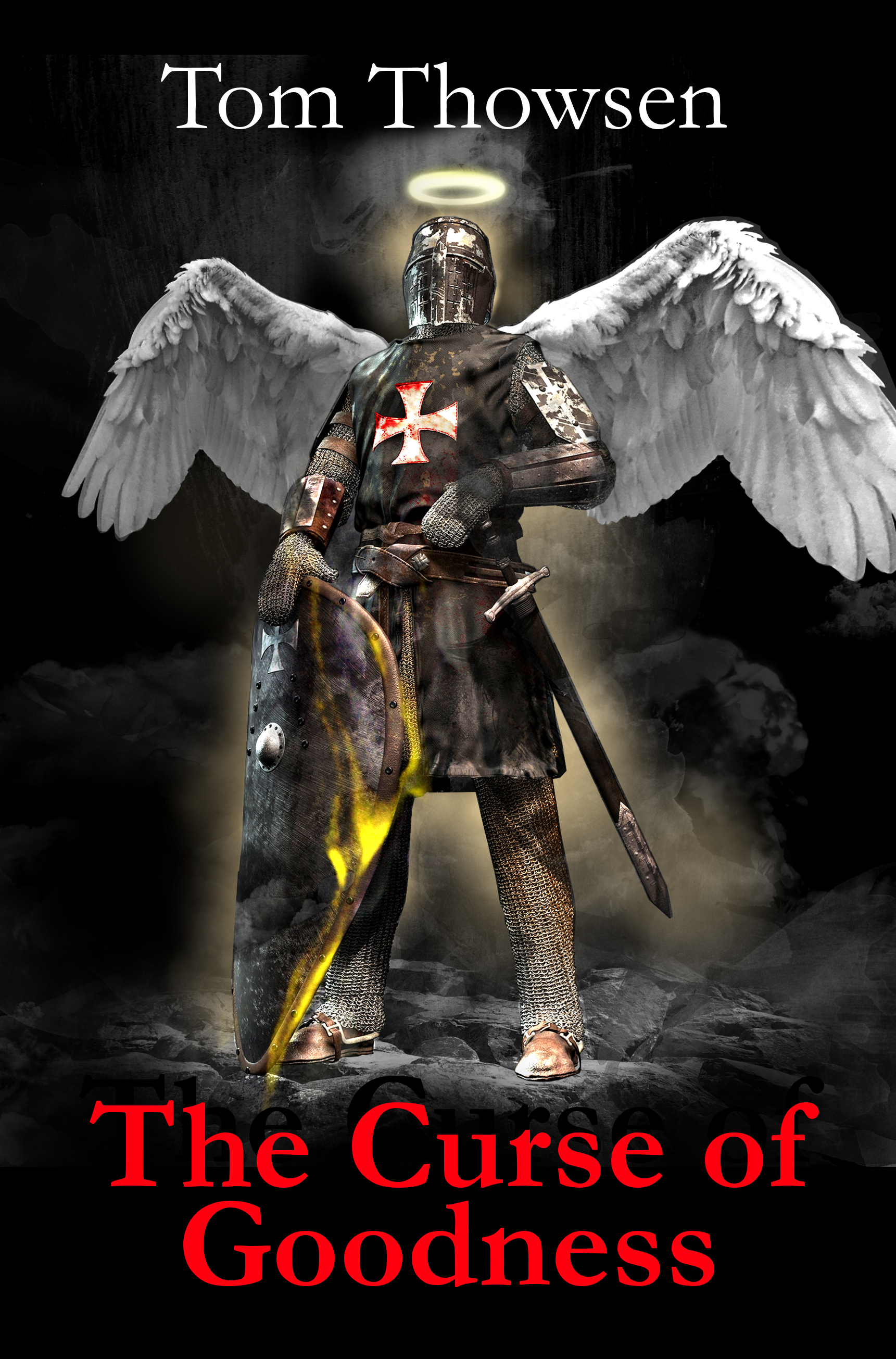
The Curse of Goodness will soon be released, perhaps at the end of 2018. This is a short novel that is related to another novel – Kayaweta. You can call it a supplement if you will. So it doesn’t matter if you have read Kayaweta or not. In “The Curse of Goodness” you hear Tubbe Eriksson`s part of the story, he is a knight who strives for the good. However, the road to hell is paved with good intentions, they say …
PS. I can give you a kindle e-book for free if you are willing to receive info from me about my authorship and coming books. Just send me an email.
Best regards,
Tom Thowsen

The letter from Tubbe Eriksson, my absolutely newest novel.

Dear readers,
This autumn is the most hectic autumn in my entire 54 age life. Soon my novel The White Lady will be released – most likely in October – thanks to my fabulous translator Catrine Bollerslev and my proofreader Anna Campbell. Great girls both. I really wish them a great future, because they deserve it. No doubt! I couldn’t make it without them, that’s for sure. However, there are other duties for me as well. At least for me as a family man.
On the 15th of September, my dear wife Irena and I finally managed to finish a wall with four new windows at our cabin, which is located on an island close to the border of Sweden. That was a lot of work as well.

But now I can focus on my authorship again, and I continuous with a small novel which is connected to my novel Kayaweta. It’s based on one of the character’s – the knight Tubbe Eriksson – and his letter to the kings of Norway and Sweden. Dated 16th of February 1372.
It’s an authentic medieval diploma. No fake.

It reads like this:
“I, Tubbe Eriksson, greet most humbly with God King Magnus and King Hakon, with God`s grace, kings of Norway and Sweden. I make known to you that I have left Örebro and I am now abiding an answer to this letter if you want to have my service and want to give me help in West Götaland – to Norway I will not go – and I cannot wait long because I have many people. Whatever you want me to do – make it known with this letter carrier. Indeed, I have other options, but will not decide upon another before I hear your wishes.”

Based on this medieval letter, that I received from one of the best researchers around the controversial Kensington stone, Richard Nielsen, I will now make a historical fiction where I use my imagination freely without any other historical facts – seen through the knight Tubbe Eriksson`s eyes and why he says:
“to Norway, I will not go …”
I would dearly interact with my readers and please don’t hesitate; just send me an email because your opinions are important to me. Thanks.

Please stay tuned.

Sincerely,
Tom Thowsen.


The White Lady

The white lady 3

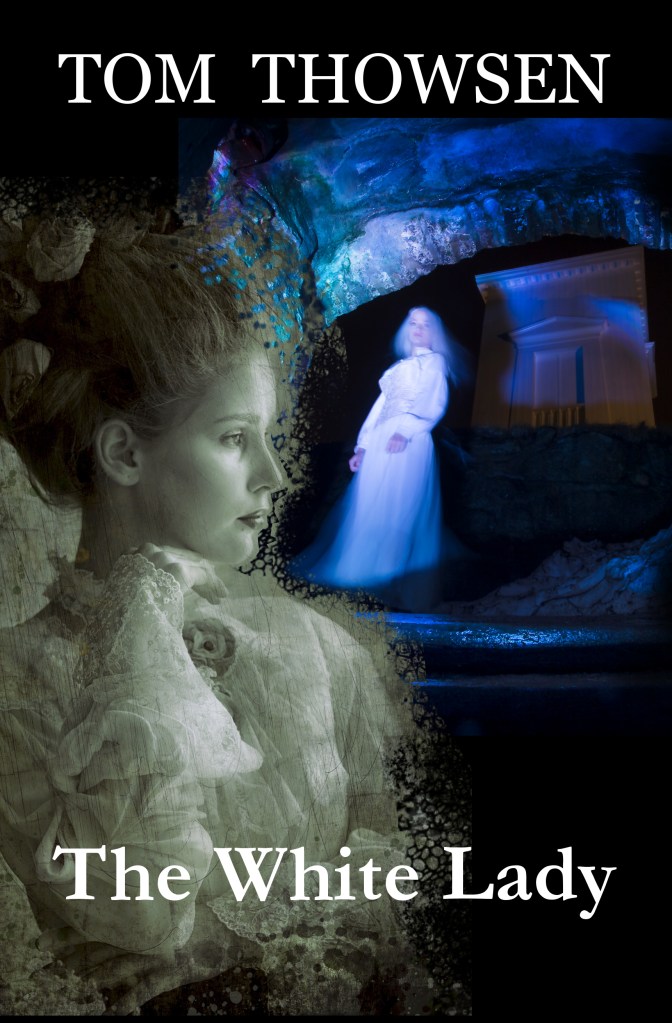
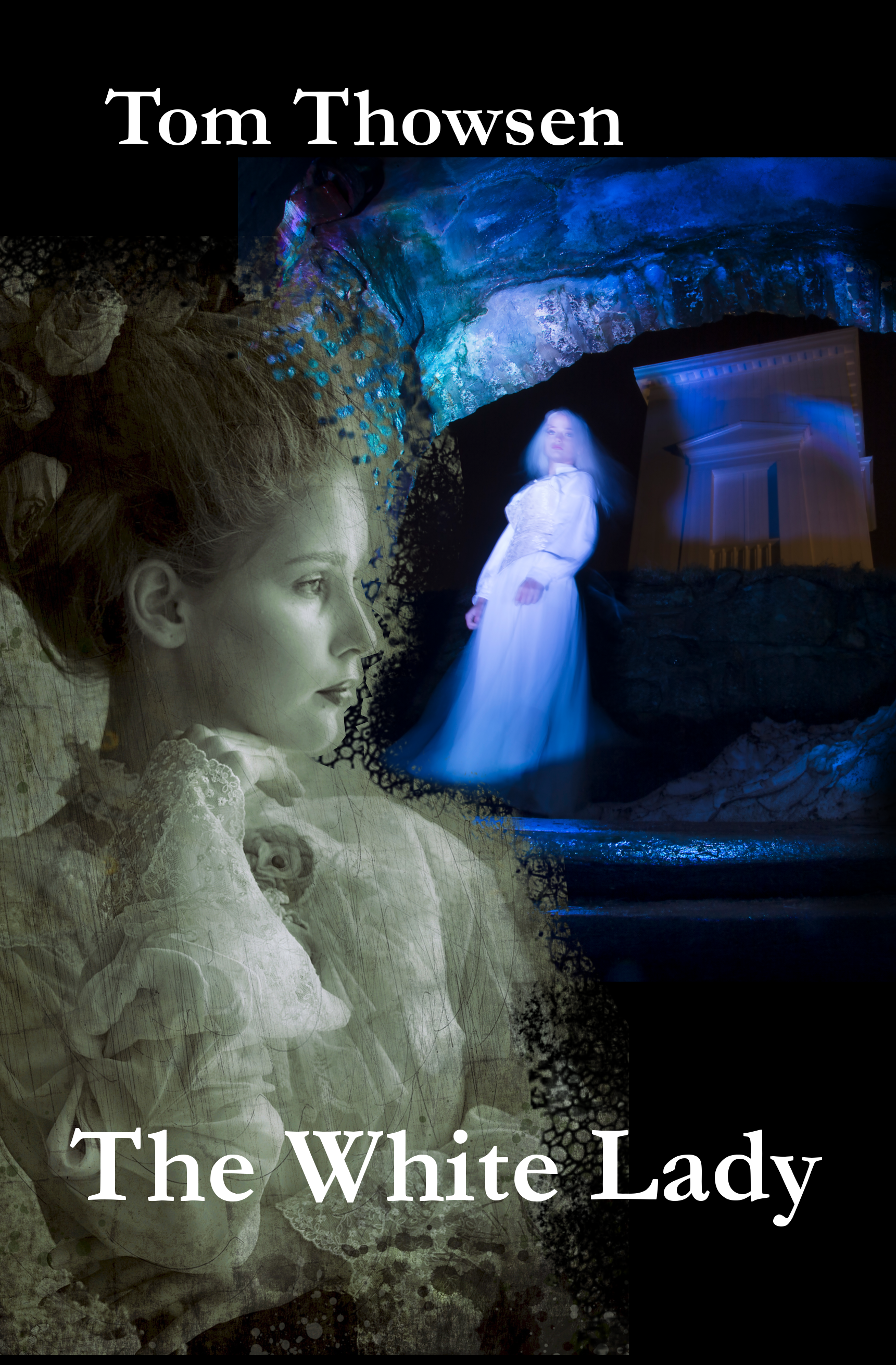
The White Lady is Tom Thowsen’s attempt at breathing new life into two urban legends from his childhood home in southeastern Norway: the tales of the White Lady and the secret passage said to exist between Fredriksten Fortress and the town of Halden. The author’s depiction of Halden is supported by his personal experience living on Festningsgata in the 80s. The White Lady follows Veronika and Frits, a young couple who purchase an old house in Borgerskansen and unearth a diary that seems to solve a century-old mystery. Who is the White Lady and why is she haunting the Fortress?

Kayaweta

Cover 6 English paperback

Short about the novel:

The archaeologists Elise and Jim reveal a discovery at Lyse Abbey, which may cause the history books to be rewritten. This leads them to a hazardous discovery journey in the United States, where Elise begins to see visions. A voice from the past tries to guide her; the mysterious Kayaweta—a Native American woman. Or is it just her imagination that fools her. All of this becomes two stories woven together into one. From the Middle Ages and the present. With knights, monks and Native Americans. Love, power struggle and drama. The relationship between Elise and Jim is also put to the test. Career, friendship—everything is at stake.

A lot of good reviews:

«The story of the Kensington Rune Stone, whether true or false, is one of the most peculiar chapters in the history of the Norse explorers. It has been written so much on the subject that it could have filled up a whole library alone. But strangely enough, no one has ever written a suspense novel based on this fantastic story – until now. «Kayaweta» tells an exciting tale in the most breath-taking way, a good read from page one to the very last sentence – a page turner all the way!»

Knut Rage, Executive Manager, Tysnes Public Library(Norway)


“I was thrilled to discover that Tom Thowsen’s ”Kayaweta” is now available in English. This Norwegian’s novel is a real page-turner. I finished it in a single night shift. It is two stories in one; twice the bang for your buck. The main characters for the modern part of the story are very likable college students, who are working on an excavation of a medieval Monastery in Norway. Their discovery of a map that should not exist sets them on a wild journey of intellectual discovery, academic cover-ups and even a high-speed chase ending in gunfire. Thowsen’s sparse style uses sharp dialogue and a gradually feeding in of clues that make the reader feel like they are there. You get drawn in and really care what happens to these grad students, as they are sucked into a conspiracy that they are not ready for, concerning a runestone that really was discovered in the middle of America, dated 1362, that was discovered in 1898. It is the interplay of fiction, historical fact and investigatory speculation that makes “Kayaweta” unique. The title character lives in the mid-14th century and is married to Paul Knutson, a Norwegian explorer that was sent to America, then known only as Vinland, to compel the Viking settlers, who fled the Greenland colony to live with amongst the Native Americans, to return to Christianity, pay their tithes to the church and recognize the authority of the king of Norway and Sweden. When a second Norwegian expedition arrives to see why Knutsson did not return, a conflict develops with the Knights Templar. It was a stroke of genius to add a band of monks, including the renowned astronomer and map-maker Nicholas of Lynne to the expedition. Knutsson’s daughter also shows up in America and she is not too happy to discover her father’s Native American second wife. I do not want to give too much away, so I will simply say that Thowsen’s medieval tale presents his best explanation of how and why the Kensington Runestone was created and left in Minnesota and why academics continue to argue about it. It is the author’s hope that his novel will inspire the readers to follow up with some research of their own. He runs a very active facebook group of amateur researchers called “The Kensington International Supporters Club” and provides several leads in his book that are worth looking up. Reading “Kayaweta” might just launch you onto your own intellectual adventure if you get bit by the runestone bug.

By Erik Sven Rurikson 6-17-2018»


This novel has also received good feedback from Norwegian newspapers:

“Thowsen manages to combine facts with fiction and writes excellent novels.”
Halden Arbeiderblad

“The author sparkles with the joy of storytelling and knowledge.”
Demokraten.